It’s a young beach, by the reckoning of oceans and stones. Still and silent under nearly a mile of ice just 12,000 years ago – now the beach is carpeted with coarse gravel over a thin layer of grainy sand and clay. Now it is called Lisabuela Park; before this it was just Lisabuela. Before that, it was surely known by another name to another people, now lost to memory. And before that, it was known by the cries of eagles and gulls, the lap of cold water rattling stones, wind rubbing leaves and needles, all in some very particular way.
It is not called Sweet Drinking Water Meets The Salt, nor Taking All The Trees, nor even Mrs. Vanderhoef Fell Off Her Steamboat Here, though all of these tell a truth about it. It is Lisabuela, and the name is sublimely, ironically arbitrary. In the 1890’s the first hopeful postmaster on the western side of Vashon Island suggested to the registry bureaucrats in Washington, D.C. that they choose the name for the island’s second post office. Anything would be acceptable, as long as it was ‘different’. What came back with the permit was ‘Lisabuela’. As near as could be guessed, it was the concatenation of the names of two employees in the land registry office.
The beach lies at the end of a narrow, densely wooded and shrubbed canyon. The stream that drains the bluffs and hillsides beyond and cut the canyon is called Jod Creek, for no reason known to anyone now. It empties into Christianson Inlet, named for a family that homesteaded there. The inlet opens out to Colvos Passage, and this name is no more than the contraction of an able-bodied seaman’s surname that was too cumbersome to pronounce fully. The names lay on top of their places, fluttering scraps of culture.
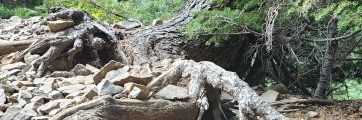
Great driftwood trees, enormous grandparent trunks, lay sleeping on the beach. Their intricate weathering tells stories, frozen dances of wind, worms and water, in detail so fine a human lifetime would not suffice to tell them all. The trees wear badges of lichen, and their upended roots reach skyward, no longer bringers of sustenance but dancers in a graceful ballet of decay. Sprigs of bunchgrass grow in sculpted hollows, anchoring a few tablespoons of soil and crumbling wood. A cellular memory of centuries leaks into the sand, a few crumbs at a time. It mixes with the memories of stone and water, with the memory of air that travels endlessly around the world, returning briefly to touch this beach again. The remembering of this place speaks to me strongly, more so than most places I see and walk through. I come here to try to understand why; it is one of my favorite mysteries, and its answer dances just outside my awareness, tantalizing.
A pleasure boat races through Colvos Pass at mid channel. The noises of the motor and its prop tearing through the water are separated from the geologic sounds of trees, birds, water on stone. It is a new and somewhat jarring memory that the place absorbs, along with the rumble of logs sliding down skid roads, the dialogue of five generations of our people, the hammering of nails into raw boards, beams and shingles, the tractors, cars, henhouses, the sound of fish flopping on the gravel in a shore-drawn purse seine. Neither Lisa nor Buela can speak to these, old or new, and to use this endearing and silly name is to express one of the great ironies of our people and our time: that we can still feel towards the land and its life, that some part of us can hear it speaking, yet we don’t know to talk back, to answer. As a people we speak in tongues of steel, heavy tongues of harvest and use. And when we do sit back for a moment in contemplation of the places that move us, then we are silent.
Minutes later, waves from the pleasure boat’s wake reach the shore, miniature rumbles coming in a rhythm and symmetry utterly unlike the waves of wind and current. Hundred million year old plants, bones, eyes and hearts – ensorced to gasoline, flamed into prop wash – the waves toss four inch high ridges of water onto the gravel. Where does this energy go next? Who can teach us to sing to glacial ghosts and boat wakes, to young stands of recovering forest peopled with relatives we almost never see?
To sit on a log by the water, using time and effort to mute the cacophony of our living, allowing it to untangle and become still. To be quiet and open, and then to discover an expression for the knowledge and perception that arrive – our culture does not recognize these as work, they are not given a respected place in us. Yet they are a crucial part of us, of how we move through the places in which we live.
Now is a good time to find a place that speaks to us clearly, whose memories come up through the soles of the feet, come on the salt or sweet winds, into the skin. Now is a good time to listen carefully, to wait patiently for the song of that place, to learn to sing it with whatever voice we may find.
This piece first appeared in a 1997 issue of the Vashon Island Chapter Audubon Society Newsletter.
 Richard Jones